


Report the ad
What Is Option Hedging? Types, Strategies, and Examples. - Bangalore
Tuesday, 29 September, 2026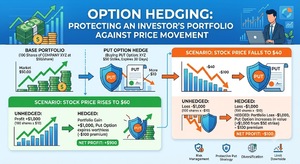
Item details
City:
Bangalore, Karnataka
Offer type:
Offer


Item description
Option hedging is a risk-management strategy where an investor or business uses options contracts to protect against unfavorable price movements in an underlying asset such as stocks, currencies, commodities or interest rates.
An option gives the buyer the right but not the obligation to buy or sell an asset at a predetermined price (called the strike price) within a specified period.
Types
1 - Protective put
Option Used - Buy Put
Main Purpose - Protect against falling prices
2 - Covered Call
Option Used -Sell Call while holding asset
Main Purpose - Generate premium income and partially hedge
3 - Collar
Option Used - Buy Put + Sell Call
Main Purpose - Limit both downside and upside
4 - Currency Option Hedge
Option Used - Currency Call/Put
Main Purpose - Protect against exchange-rate movements
5 - Commodity Option Hedge
Option Used - Commodity Call/Put
Main Purpose - Protect against commodity price changes
Simple Example: Suppose you own shares of a company currently trading at ₹1,000 per share. You are worried that the share price might fall, but you don't want to sell your shares. Instead you can buy a Put Option with a strike price of ₹950.
• If the share price falls to ₹800 → the put option can help protect you because you have the right to sell at ₹950.
• If the share price rises to ₹1,100 → you can continue holding the shares and benefit from the increase.
• You pay a premium for this protection.
So, the put option acts somewhat like insurance against a fall in the share price.
An option gives the buyer the right but not the obligation to buy or sell an asset at a predetermined price (called the strike price) within a specified period.
Types
1 - Protective put
Option Used - Buy Put
Main Purpose - Protect against falling prices
2 - Covered Call
Option Used -Sell Call while holding asset
Main Purpose - Generate premium income and partially hedge
3 - Collar
Option Used - Buy Put + Sell Call
Main Purpose - Limit both downside and upside
4 - Currency Option Hedge
Option Used - Currency Call/Put
Main Purpose - Protect against exchange-rate movements
5 - Commodity Option Hedge
Option Used - Commodity Call/Put
Main Purpose - Protect against commodity price changes
Simple Example: Suppose you own shares of a company currently trading at ₹1,000 per share. You are worried that the share price might fall, but you don't want to sell your shares. Instead you can buy a Put Option with a strike price of ₹950.
• If the share price falls to ₹800 → the put option can help protect you because you have the right to sell at ₹950.
• If the share price rises to ₹1,100 → you can continue holding the shares and benefit from the increase.
• You pay a premium for this protection.
So, the put option acts somewhat like insurance against a fall in the share price.

Related ads

Hedging is a risk-management strategy used in trading and investing to reduce the impact of…

Currency hedging is a financial strategy used to reduce the risk of losses caused by changes in…

Swap hedging is a risk-management strategy used to protect against changes in interest rates…

What Are Call Options? A Call Option gives the buyer the right, but not the obligation to buy an…

Learn how to trade options confidently with our specialized Options Trading Course that covers…

Master the art of options trading with our comprehensive course designed for all levels. Learn…

The Innovation Process is the structure that ensures your innovation team has novel ideas and the…

Learn powerful option strategies with ICFM India’s Options Trading Course. Understand calls, puts…

Shareway Securities constantly help the investors with strategies for Commodity investment…
Smart Hedging, Limitless Earning—Power Up with Our Trading Bots! (Delhi)
Increase your trading productivity with a trustworthy and profitable hedge trading bot. Precision…
