


Report the ad
Swap Hedging: Meaning, Types, Examples, Benefits and How It Works. - Bangalore
Thursday, 1 October, 2026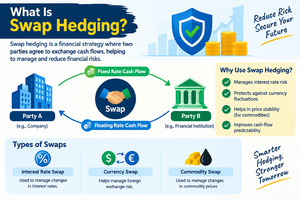
Item details
City:
Bangalore, Karnataka
Offer type:
Offer


Item description
Swap hedging is a risk-management strategy used to protect against changes in interest rates, currency values, or other financial risks. It involves using a swap agreement to exchange one type of payment or cash flow for another.
Simple Example:
A company has a loan with a floating interest rate. If interest rates rise, its loan payments may increase. The company can use an interest rate swap to exchange the floating rate for a fixed rate, helping make its future payments more predictable.
Main Types of Swap Hedging and Other Related Topics:
• Interest Rate Swap – Used to manage changes in interest rates.
• Currency Swap – Helps manage foreign exchange risk.
• Commodity Swap – Used to manage changes in commodity prices.
• Swap Agreement – A contract where two parties exchange specified cash flows.
• Benefits of Swap Hedging – Can improve cash-flow predictability and help manage market risk.
Conclusion:
Swap hedging can help businesses and investors reduce exposure to market fluctuations and plan their financial obligations more effectively.
Simple Example:
A company has a loan with a floating interest rate. If interest rates rise, its loan payments may increase. The company can use an interest rate swap to exchange the floating rate for a fixed rate, helping make its future payments more predictable.
Main Types of Swap Hedging and Other Related Topics:
• Interest Rate Swap – Used to manage changes in interest rates.
• Currency Swap – Helps manage foreign exchange risk.
• Commodity Swap – Used to manage changes in commodity prices.
• Swap Agreement – A contract where two parties exchange specified cash flows.
• Benefits of Swap Hedging – Can improve cash-flow predictability and help manage market risk.
Conclusion:
Swap hedging can help businesses and investors reduce exposure to market fluctuations and plan their financial obligations more effectively.

Related ads

Currency hedging is a financial strategy used to reduce the risk of losses caused by changes in…

Hedging is a risk-management strategy used in trading and investing to reduce the impact of…

Option hedging is a risk-management strategy where an investor or business uses options contracts…

What Are Call Options? A Call Option gives the buyer the right, but not the obligation to buy an…

Learn how to trade options confidently with our specialized Options Trading Course that covers…

The literal meaning of Garbh is womb, and sanskar means values, ethics, or morale. Together, the…

Adverbs are words that change the meaning of a Verb. There are list of Adverbs and the types of…
Understanding Commodity Futures: A Beginner’s Guide to Trading (Mumbai, Maharashtra)
Commodity futures are an essential part of global financial markets. They allow traders and…
BTS/RF Engineer Requied (Chandigarh)
Engineer is responsible for the analysis, design, implementation, optimization and enhancement of…
